Showing posts with label teastory. Show all posts

5 Mar 2016

Coffee vs. Tea // part III

(Part I)
(Part II)

Juxtaposition
In the last part, I talked about taste, a very important and extensive subject. While one may decide for or against a certain beverage because of its taste, this is not the only aspect. Especially when preparing the thing at home, convenience and price, for both the material and equipment, are just as relevant. In this part, I will discuss the pros and cons of both coffee and tea preparation methods and how achievable the different quality levels are. Note that I will only include the preparation of the pure beverage, and not how you serve or combine it, since this is a whole nother subject.

Preparation and Convenience.

Coffee first again. These are the most popular techniques of making it I think.

When you think filter coffee, you'll probably think of a classic filter coffee machine. These are quite convenient, as you basically just put water and ground coffee inside and press the button. The machine itself costs around €50 - 150, and you can put all sorts of coffee inside, as long as it's ground coarse enough. You can produce big amounts at once and need neither extra equipment nor any monitoring. On the other hand, you have no control over temperature and brewing time.


If you'd rather like to control these and give up some convenience in exchange, you can roughly do the same process manually. Just get a drip cone you pour the water over yourself. When trying to get the infusion time and water distribution right, you'll discover that method not really to be suitable for that big amounts (and that infact also applies for the machine version, you just don't see it in there).


Greater amounts of filter coffee should better be prepared via full immersion brew. The prototype device is a french press, available from under €5 up to high end versions. Just put ground coffee inside, boiled water on top, wait a few minutes and press the sieve down to seperate the two. You can serve directly from it. The need of an external hot water source could be seen as a con, but also allows this to be used when there's no electricity, e.g. with a camping stove and a simple pot.


Next is the moka pot. Sometimes untruly called espresso maker, this is the classic Italian home device for rather small quantities of more intense coffee. The price range is similar to the french press. You need finer coffee grounds, so the price range of this will probably start a bit higher than for filter coffee. Put water in the lower part, coffee powder in the middle sieve and screw the pot on top of it. Then it's heated on a cooktop or similar until the water presses itself up.


Now to real espresso. You will have to spend at least some hundreds for a reasonable portafilter machine. The principle is to bring water through very fine ground coffee with a lot of pressure. You usually grind your coffee direclty into the portafilter and then lock that to the machine. These come with a spray lance for frothing the milk for e.g. cappuccino. You'll probably be very interested in espresso to own one of these, since this is definitely the most inconvenient device.


There's of course also the fully automatic machines which mix several coffee drinks for you at the push of a button. These are usually a hygienic mess and completely eliminate the human part from the process, which is just awful in my opinion. Especially when working with these ridiculously overpriced, environment-killing aluminium capsules, they should really be illegalized I say.


As you can see, coffee beans often need some, or even a lot of technologic assistance to transform into a drink. Using a machine can improve the convenience for the moment, but comes with rather high entrance costs, and machines will need replacement after some time. Less technological brewing techniques are not as expensive, and give you a better connection with the drink. They require more attention and time though, as well as more manual dishwashing probably. In exchange, these utensils such as a drip cone are virtually usable forever.

Now tea.

The variety of gadgets assotiated with making tea is a bit more manageable. There are actual tea machines (water boiler, infusion can, serving can), or the Russian samovar, as well as different portable devices around, but first, I don't think any of these are really common, and second, they really just try to combine the steps of making tea into one connected object and don't reinvent the wheel concerning the extraction process etc. However, there are different aproaches to make it.

In these parts, the most popular way is brewing your tea "Western style". You'll probably use black tea for that, but it works with every kind. You put the leaves into some sort of a strainer inside a big pot or cup, pour boiling or hot water over it and let it infuse for a couple of minutes. Then the strainer is removed and you have all the tea you want at once. Very convenient. High quantities are well possible, and all you need is a vessel, a strainer and a hot water source. Some attention is required of course in order to get the time right.


The direct competitor would be regular Eastern style, used in the Chinese tea ceremony or how you'd like to call it. Brewing this way, you let the leaves steep very shortly and multiple times, instead of extracting all the aromas into one brew. This reasonably requires a way smaller pot which has to be emptied completely after each infusion. Either you use a second pot/pitcher for doing so, or you distribute it directly to the attendees' cups. You'll need something to keep your water hot, and a higher quality whole leaf tea for this to work. Intact leaves can hold their aroma for the longest and won't slip out of your brewing vessel. The process of making tea intentionally takes centre stage here, hence you can't really say it's inconvenient, but it sure requires all your attention.

The Japanese tea ceremony involves drinking powdered green tea, Matcha, but also several other things and actions, so you can't really speak of performing one just because you're traditionally preparing Matcha. Still, it's a very unique kind of tea and tea making. You'll at least need the special bamboo whisk, the Chasen, and a suitable drinking bowl. One to two teaspoons of powder are placed in the bowl. You add less than a cup of warm water to it and whisk it. To get a fine foam top, some practice is required, but it's easy to learn I think. It's a rather laborious technique since you have to prepare every serving individually. However, Matcha can also be ulilized quite simply by shaking the powder in your water bottle or the like.

At last, there's the vexed teabags. Possibly even more popular than the Western style I described above, they basically imitate the same process. Very small broken tea leaves are delivered inside closed textile (?) or plastic filter bags which can directly be put into any sort of vessel. After brewing, you just pull it out on the yarn and throw it away. Maximum convenience I guess, but also maximum tea trash inside (for the most kinds). You'll regularly not find any good quality, and the bag materials always bring in some unwanted chemicals or residues.


I tried to cover the different ways of preparing both of the hot drinks, well knowing that there are dozens of other approaches that I just don't know enough to write about, e.g. middle eastern traditions for both coffee and tea preparation. Neither drink is exclusively simple or complicated, rather is tea more of a manual thing, while coffee requires or allows the use of tech. The next part will be about contents and possible health aspects.

Thanks for reading!


10 Feb 2016

About this Tea and Me and this Blog // part III

Part I: http://chazichaxi.blogspot.de/2016/01/about-this-tea-and-me-and-this-blog.html
Part II: http://chazichaxi.blogspot.de/2016/02/about-this-tea-and-me-and-this-blog.html

Hello, my name is Christian, and I am infatuated with tea. Logically, that hasn't always been the case.

For some time, I sticked with making full-western single-long-litre-infusion black tea with a steel sieve in my glass pot, while improvising the XL-Gongfucha for green tea. 
In the long run? Not satisfying! I planned some change.

For the next part, I can't put the story straight anymore. So here's a list of things I purchased or received as gifts to improve the process (close to the real chronological order):


  • A Tokoname Kyusu (Japanese side-handle teapot)
  • A bamboo teatray
  • A steel waterboiler with temperature selection
  • A machine-(but well)-made Zisha teapot
  • An untreated/unenamelled Tetsubin (castiron kettle)
  • Some Japanese cups
  • A Yuzamashi (Japanese cooling vessel)
  • A thermometer
I could, of course, continue this list until today, but these are the items I got early and quite quick one after the other, quasi composing my "starter kit". As you can see, the equipment was mostly Japanese at that moment. As green tea from Japan was the tea I priorized for treating more elaborately, this made the most sense. Parallel to that, I stacked up all the Japanese greens you should've heard of: Sencha, Shincha, Gyokuro.

My momentum was irrevocable now. After having read about the basics of the six traditional tea kinds,

White - Green - Yellow - Oolong - Red - Dark

and that's just the lower left corner of the shelf.


I tried to get a picture of everything. I became a multi weekly guest in my local tea shop, strictly buying organic farmed tea, by the way. Still sort of blindly experimenting with all of it, I read loads of stuff on the internet, actually experiencing more confusion with every other information. Since my first belief was the possibility of a strict allocation of water temperatures, doses and steeping times for every kind of tea, I looked for rules about that. It turned out to be more complicated. The story as well becomes even more unstraight going further on.

I saw that I unfortunately wouldn't find all too much really special and personally traded tea in my local shop. It's not that they only blindly buy and sell things from wholesalers. They do travel to Japan once in a while and meet with some organic farmers there, but of course a vendor basically selling everything you can and cannot call tea cannot network with all the farmers. So I looked for other places for other teas. A really well-assorted (online) shop I found is luckily at least located in Germany, so I could order his stuff without month-long delivery times I later came to know when ordering directly from Asia. The organic aspect was somehow omitted in this process, as I believe reasonable farmers don't need certifications for not spraying anyway. 
And so goes on the story. 

More pots and Gaiwans, more cups, more coasters, more vendors, and of course more teas.

Having read Stéphane Erlers "Tea Masters Blog" (teamasters.blogspot.tw) for a while, I learned and got excited about Chá Xí (茶席). Ever since I tried it out, I close-to-never used my bamboo tray again.

Chá Xí is a concept of combining practicability with form, and enhancing completing a tea ceremony experience with the visual aspect of well-composed and wisely selected teaware on a mat, blanket, cloth or basically what you want and deem harmonious with the selected tea and ware. Composing a Chá Xí helps me find my focus for the tea and somehow myself subsequently as well. I started arranging Chá Xís on my table, but recently migrated to the floor, where they are traditionally performed (like most things in Asia I guess).

Leading to the "about this blog" part, the last part of the story: While the second half of the name should be clear by now, the first half is a bit more cunning (hehe). It has three meanings:


  1. Zi simply as the first two letters or first syllable of my last name (Zieger)
  2. Chá Zì can be understood as 茶渍, meaning tea stains. They sooner or later occur somewhere when doing Gongfu Cha. This is sure.
  3. Chá Zì can be understood as 茶字, meaning tea word, tea symbol, or tea letter. I thought this to be a nice allegory or maybe pars pro toto for a tea blog.


Thanks for reading!

6 Feb 2016

About this Tea and Me and this Blog // part II

Part I: http://chazichaxi.blogspot.de/2016/01/about-this-tea-and-me-and-this-blog.html

Hello, my name is Christian, and I am infatuated with tea. Logically, that hasn't always been the case.

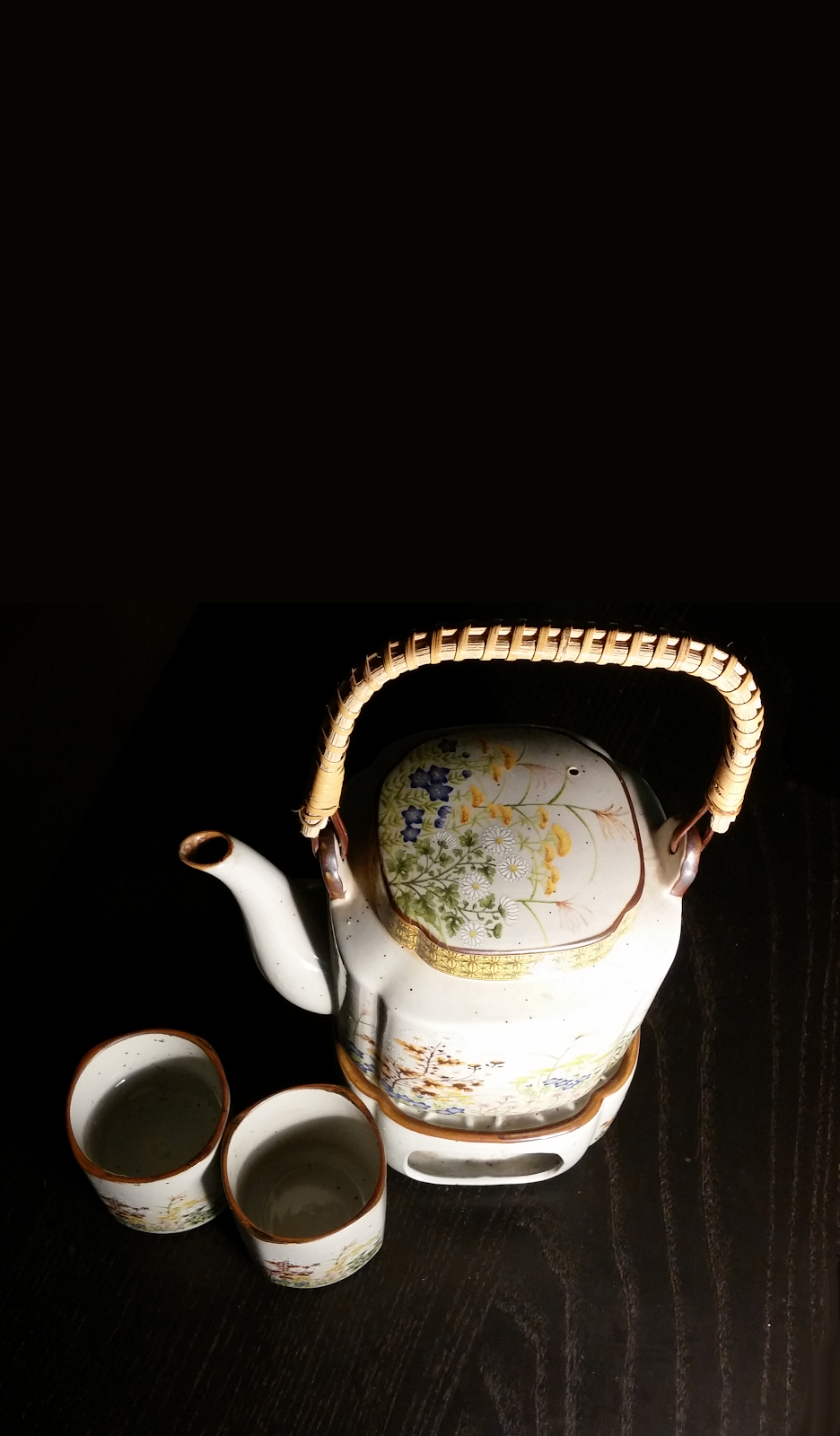
While planning to move into my first flat, I once ran into my parents' neighbours who were just sorting out some stuff from their house, and they happened to have an old teapot with matching tea warmer and cups to give away.


It felt somehow Asiatic with its whole flowery design, cups without handles and the overhead bamboo holder. The pot even came with incorporated strainer holes at the spout's base. Owning a teapot of course moved me to stock up on (bag) tea which I soon accustomed myself to drinking nearly every day, by the litre. Besides the standard "real tea" lone warriors, namely random green tea and Darjeeling, it was really a selection of tisanes, herbals & co that I picked from.

One day, my sister and I spotted a cute manatee shaped sorta-tea-egg, which she subsequently gave me for my next birthday. Reasonably, she got me a loose tea to it, an organic gunpowder. The manatee unfortunately turned out to be very suitable neither for expanding tea leaves nor water amounts over one cup. Well. Back to drinking mostly the bags then. It wasn't meant to be yet.

Until I ordered a Sencha in an alternative café and got it served as a nice mini Gongfu Cha setup. Two glass pots and a small cup on a bamboo tray, with the right-tempered water in a Tetsubin aside. I found it too uncomfortable to ask how it worked, but was luckily able to figure it out myself. It carried me away!


Soon I bought me a second teapot (a one-litre glass one) to recreate the method at home, putting my gunpowder tea right into the porcelain pot. I experimented with shorter steeping time and a second or sometimes third infusion, with less water for each.

Slowly approaching the real thing.

Thanks for reading!

28 Jan 2016

About this Tea and Me and this Blog // part I

Hello, my name is Christian, and I am infatuated with tea. Logically, that hasn't always been the case.

At some point in life, I assume, most people are confronted with their first hot beverage of some kind. I further assume that this will most probably be either coffee or tea, or other infusions generally lumped together with tea at least in these parts. While coffee is quite improbable to be liked by children or youngsters at first. In my case, coffee wasn't even a much available option to try, for my parents have always been drinking tea (good ol' Earl Grey) in the afternoons. Made with loose tea in a tea machine (basically an infusion-pot-and-serving-pot-beneath-a-water-boiler-solution), a tool I have never seen at anybody's place other than theirs. Another salient childhood/early youth "tea" experience of mine is drinking fruit infusion from teabags in the youth hostel on school trips, completely oversaturated with sugar in an attempt to compensate for the lack of any soft drinks in these places. 

So after changed from drinking milk to drinking Earl Grey with my family, I developed a 

"tea > coffee"

-attitude. Since I easily feel an aversion against widespread things and opinions, I found it quite fancy to be preferring a cuppa tea over coffee. Also, I wasn't very impressed by coffee, while not completely disliking it, though.

Still - at this point I did never have a single thought about what tea actually was (and probably also not about the difference between tea and "tea", i.e. random things thrown in a tea bag).

Thanks for reading!